Case Study: Vision Issues and Body Stiffness
I had a mildly unusual case come in today that seemed worth sharing, especially as it bridged sensory and musculoskeletal symptoms/systems.
My patient came in with increased global bodily tightness following some cycling and yoga, enough that she couldn't sleep until she got up and stretched pretty thoroughly. Also, a couple days later she had a brief period where she had a "C" shaped pattern of blurry movement "almost like a sun spot" in the lower left side of her right eye's vision, and then it switched to that same lower left side of her left eye. That…is a weird one, but the presentation gives us a place to look to start with and we can go from there.
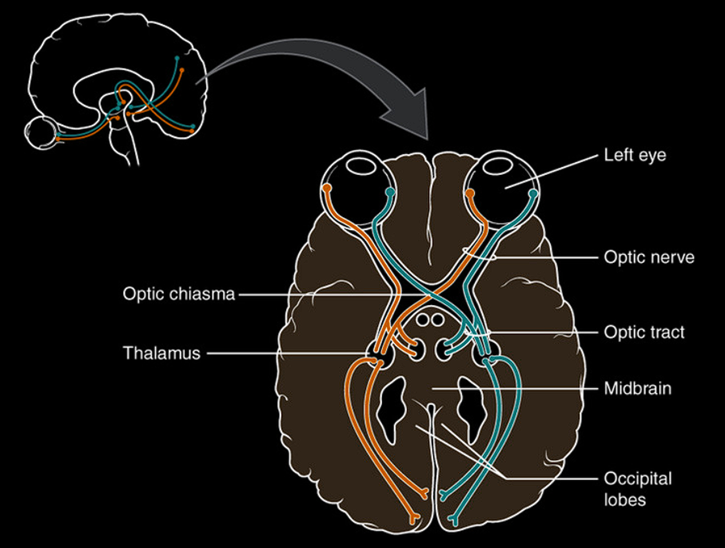
Each of our eyes are actually supplied by both optic nerves, with each nerve splitting just about at the level of the front of your ears to send a branch both left and right, but importantly for this the left optic nerve supplies the left side of both eyes. This means if we have something weird affecting the left side of both of the eyes, I'm going to consider the left optic nerve as our place of irritation, and given the lower left presentation, I'm thinking there may be an irritation in the optic nerve around where it transits the parietal lobe.
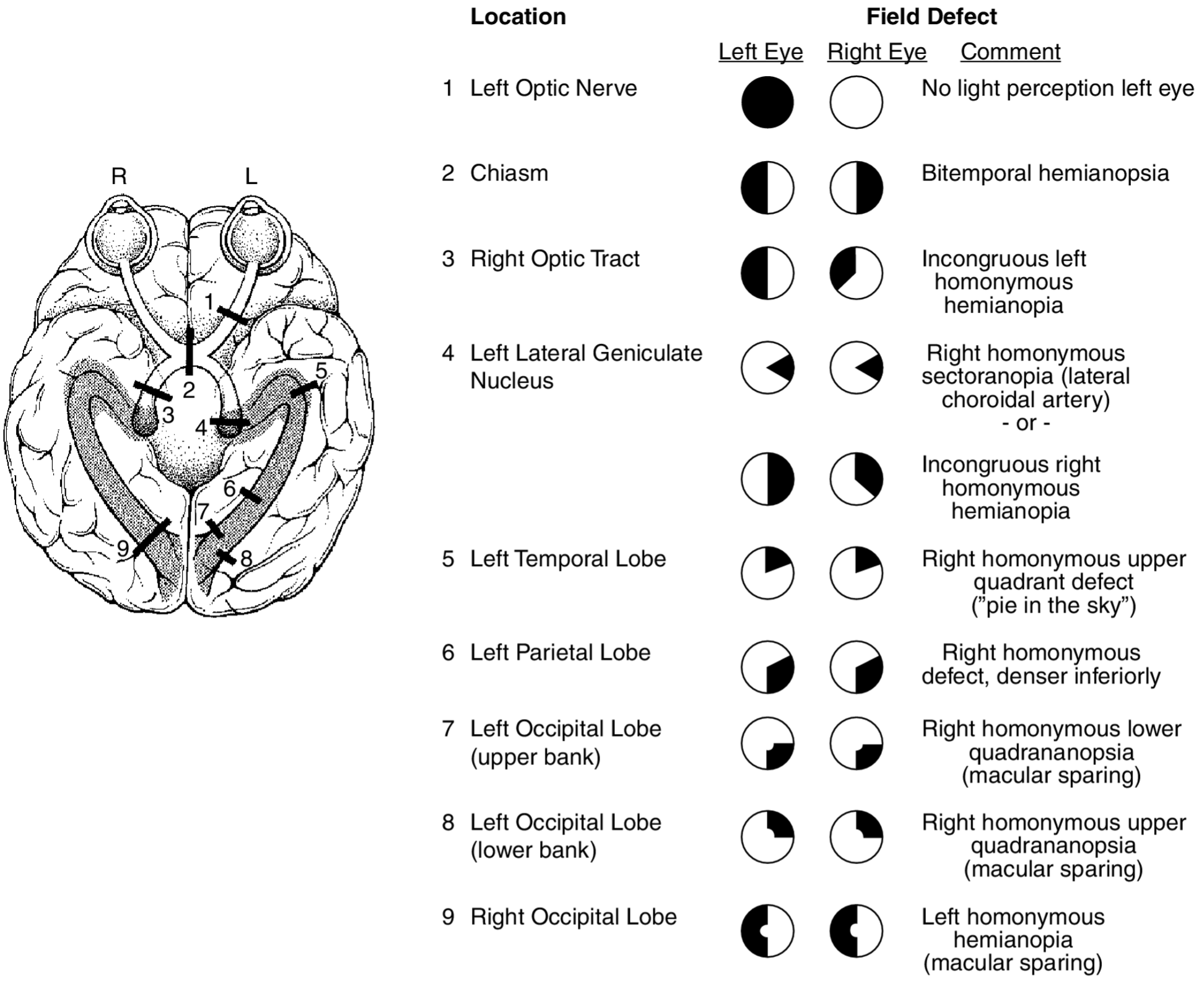
If you look at the black and white picture attached, it shows (in black wedges) what portions of our vision would be affected by damage in different parts of the brain or optic nerve. But this doesn't just have to be full loss of vision from something more catastrophic like an impact, stroke or aneurysm, it can also just present as irritation and on rare occasions some weird vision disturbances like these.
Also, while this is for vision and not specifically oculomotor (eye movement) issues, the brain knows that if there's a visual problem (whether it's an irritated nerve, or part of vision processing in the brain that's having deficits), looking in the direction of that issue is going to load it further and we can often directly see the results of this. This lets us check 'oculomotor function' by watching the patient track the tip of a pen in circles and see if they cut corners/stretches, jump ahead, have a lot of blips or other movement issues in certain ranges, or actually describe certain directions as difficult or uncomfortable. This patient did have discomfort and movement blips in the lower right range, which corresponds to that left parietal stretch of the optic nerve.
Moving on with our assessment, we went for a cranial vertex 'listening' (an osteopathic term where we proprioceptively feel for the autonomic nervous system tightening connective tissue to 'hug the lesion' [aka the irritation in the area]) and we got pulled directly to the left parietal lobe, with an encephalon/dural quality (a mixture of smooth membranous movement and a deeper more amorphous end to the proprioceptive pull).
So everything is stacking up so far in pointing at the left optic nerve as it transits the parietal lobe, but to wrap up our assessment we need to check the optic nerves themselves by mechanically assessing the eyes. Both had a 'local listening' pulling us into the left optic nerve.
Speaking towards the body tightness briefly, we did find some musculoskeletal irritations and deficits (some of the R kidney 'retro' pattern melding into the pudendal nerve pattern I've written about here before), visceral gunk (a lot of organs pulling towards midline towards nerve plexi) and a fair amount of dural irritations as well, which can specifically lead to global stiffness. So her symptoms are all lining up.
We started working on the left optic nerve as the more direct route, feeling the fluid slowly compress in a pressure wave back to where we find resistance, getting a sense of our pressure moving laterally along the optic nerve route, back to midline, then slooowly back after the chiasm (where the nerve splits left and right as they move towards the eye). As we get to that point of irritation we get a few fluttering 'bumps' and then it stops. I sometimes think of this pressure portion like squeezing a water bottle (but…slightly gentler…) to get a dent out, while it's also giving the nerve some slack from any tension, though most of our treatment is in the process slooowly taking off that pressure and letting it decompress back to neutral. It's one of my favorite manual techniques because it uniquely feels like pushing a log into the water and feeling its buoyancy pushing back on you. Once we get back to neutral we carry out a slight tensioning and follow any inductions (another osteopathic description in working with the autonomic nervous system in a way that feels like a bit of a dance) until it goes quiet. This (and at the end of compression) is also where I add my ophthalmic vagus stimulation for the direct functional neurology side.
We repeated the process on the right, with it being similar, but with less palpable irritation and it went much quicker.
After this we reassessed and the eyes no longer pulled into the optic nerve, the vertex cranial listening pulled towards the dura instead of into the parietal lobe, and the smooth pursuits (eye movements) were easy and smooth. The dura itself was moving easier and her muscular function and visceral issues all had dropped down considerably. We did follow up with some work to the left tentorium, the dura from C1-0, and some other treatment targets in the body, but the optic nerve irritation was really the hangup for her whole body and did most of the job by itself. The rest would probably have settled on its own, but we're certainly not going to ignore it to be as thorough as possible, so we addressed a range of other issues as well that were part of this web.
In the end a lot of our work is figuring out what the body doesn't feel comfortable doing; what it feels a need to change how it works to protect, and seeing what we need to do to rectify that. I always want to ask 'why' and chase it as far up the causal chain as we can, but for this case today I wanted to show these connections that are often not incredibly intuitive or direct, though we can definitely find them and do something about it.